
Facial Sagging

What is Facial Sagging?
Facial sagging refers to the gradual loss of firmness, definition, and structural support that occurs as the face ages. It may appear as loose skin, heavier cheeks, jowls, softened jawlines, deepening folds, or a tired facial appearance.
Although many people associate sagging with loose skin, the ageing process involves much more than the skin itself. Over time, collagen and elastin decline, facial fat compartments shift, retaining ligaments weaken, and even the underlying bone structure gradually changes.
What Causes Facial Sagging?
Collagen and Elastin Loss
As collagen and elastin production naturally declines with age, the skin becomes thinner, less elastic, and less able to resist gravity.
Volume Loss
The gradual loss and redistribution of facial fat reduces support beneath the skin, contributing to hollowing and facial descent.
Weakening of Facial Support Structures
Retaining ligaments and connective tissues become less supportive over time, allowing facial tissues to shift downward.
Ageing
Age-related changes in facial bone structure reduce the natural framework that supports the overlying soft tissues.
Sun Exposure
Long-term ultraviolet (UV) exposure accelerates collagen degradation and premature skin ageing.
Lifestyle Factors
Smoking, chronic stress, poor sleep, and inadequate nutrition may accelerate the ageing process and contribute to earlier skin laxity.
How Facial Sagging Develop Across Different Layers
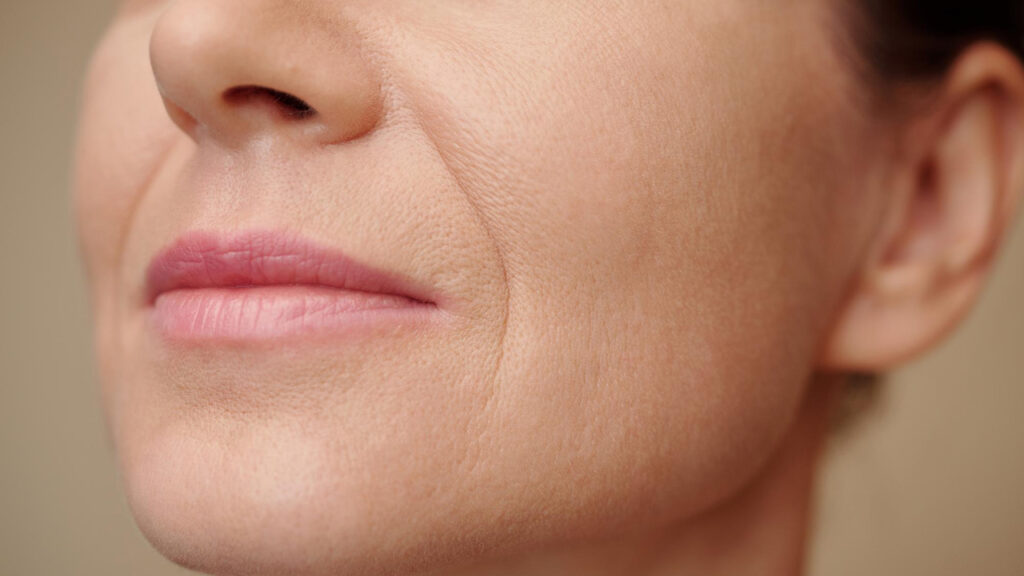
Facial sagging is often thought of as loose skin, but it is actually the result of ageing across multiple layers of the face. While changes first become visible on the surface, they are driven by gradual structural changes occurring deeper within the skin and facial support system.
Epidermis
The epidermis is the skin’s outermost layer and the first place where signs of ageing become visible. As skin renewal slows with age, this layer becomes thinner and less effective at retaining moisture. The result is skin that appears drier, rougher, and less radiant, making fine lines and skin laxity more noticeable.
Dermis
Beneath the epidermis lies the dermis—the structural layer responsible for the skin’s firmness, elasticity, and resilience. This layer contains collagen, elastin, and hyaluronic acid, all of which naturally decline with age.
After the age of 20, collagen production decreases by approximately 1% each year, gradually reducing the skin’s ability to remain firm and resist gravity. As the dermis loses strength, the skin becomes thinner, less elastic, and more prone to wrinkles and sagging.
SMAS and Retaining Ligaments
Beneath the skin lies the superficial musculoaponeurotic system (SMAS), facial muscles, and retaining ligaments that support the position and movement of the face.
Retaining ligaments act like anchor points, holding the skin and soft tissues securely against the facial skeleton. Over time, these ligaments gradually stretch and weaken, while the facial muscles lose tone and support.
Facial Fat
The face contains multiple fat compartments that provide youthful contours and natural facial fullness. With ageing, these fat pads gradually lose volume while shifting downward. This contributes to flatter cheeks, hollow temples, under-eye hollowness, and increased heaviness in the lower face. The combined effects of volume loss and fat descent further accentuate facial sagging and reduce facial definition.